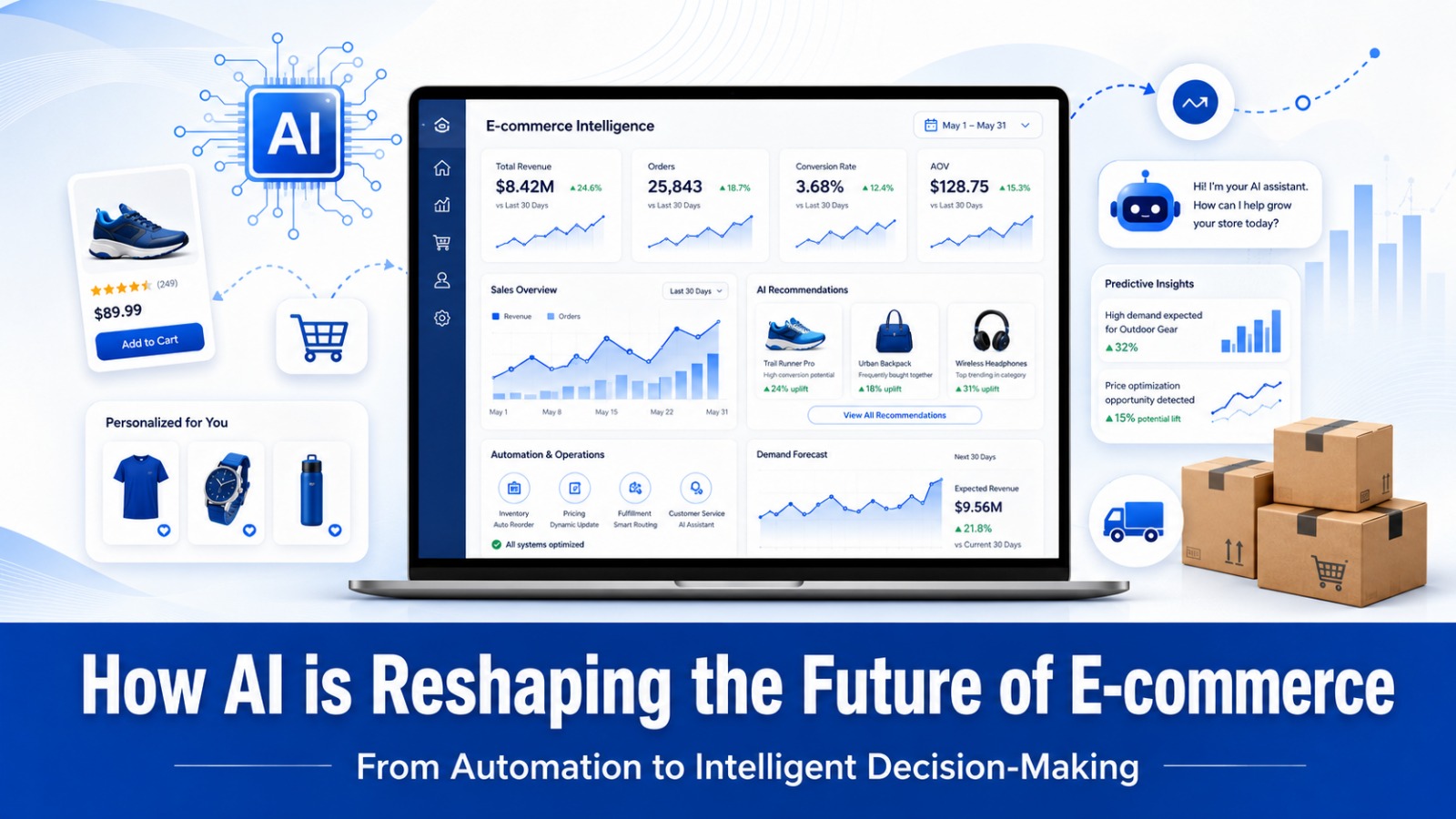
Five years ago, almost every e-commerce conversation started the same way: “How do we get more traffic?” The playbook was predictable — spend more on ads, push another discount, add more SKUs, get onto one more marketplace. That conversation has quietly changed.
Today, most digital commerce teams aren’t short on traffic or data — they’re buried in it. Search reports, marketplace reports, ad reports, inventory reports, CRM reports, each telling a different version of the truth. And yet leadership still asks the same questions every Monday: Why did sales drop last week? Why is this inventory still sitting in the warehouse? Why did a campaign bring traffic but not profitable orders?
This is where the real opportunity in AI for e-commerce begins — and it has little to do with chatbots or auto-generated descriptions. The deeper shift is about decision-making. E-commerce has moved from a game of execution to a game of intelligence. The brands that win won’t just move fastest — they’ll understand, decide, and adapt faster.
McKinsey estimates generative AI could unlock $240–390 billion in economic value for retailers, roughly a 1.2–1.9 percentage-point margin lift. But that value doesn’t sit inside the technology — it sits inside the decisions AI helps improve: what to stock, price, promote, personalize, automate, and stop doing. The future of e-commerce won’t be defined by automation alone. It will be defined by intelligent commerce.
Why E-commerce Has Changed for Good
Growth used to be linear: build the site, run ads, improve conversion, expand to marketplaces, repeat. That no longer reflects how people shop. A customer might discover a product on Instagram, compare it on Amazon, ask ChatGPT for alternatives, and finally buy after a WhatsApp nudge — one seamless journey for them, but six teams and ten dashboards on the business side.
That gap between customer behavior and company structure is driving the urgency around digital transformation. Acquiring customers has also gotten more expensive, and paid media is unforgiving of weak fundamentals — thin content, inconsistent pricing, or slow pages just get amplified faster by AI-powered marketing.
Competition has grown more layered too, with D2C brands now competing against marketplaces, private labels, quick-commerce apps, and AI recommendation layers that quietly decide which products get surfaced at all. And most businesses don’t fail from a lack of data — they fail because it’s scattered and disconnected from action. The old question was “how do we sell online?” The new one is “how do we run a business that learns continuously?”
From Automation to Actual Decision Intelligence
Most companies start their AI journey with automation — drafting descriptions, answering routine questions, firing off cart-recovery emails. Useful, but just the first layer. The more meaningful shift is to decision intelligence: using AI and real-time signals to sharpen commercial decisions. Automation asks, “can we do this faster?” Decision intelligence asks, “what should we do next, and why?”
A traditional dashboard tells you sales dropped. An intelligent commerce system tells you sales dropped because a SKU went out of stock in two regions, a competitor cut pricing, and reviews started flagging a sizing issue — all at once. This is the space where AI-driven analytics and predictive commerce are changing how businesses operate — not AI as a copywriter, but AI as a commercial co-pilot.
Where AI Is Actually Creating Value Today
The most valuable AI use cases are rarely the flashiest — they quietly remove friction from everyday decisions.
In inventory, AI can forecast demand at the SKU, region, and channel level, flag slow movers before they become markdown problems, and stop teams from promoting products they can’t fulfill profitably. In pricing, it brings discipline by weighing elasticity, seasonality, and competitor movement together — the goal is smarter pricing, not deeper discounting.
In merchandising, AI can surface search gaps and unmet demand a human might miss — like customers repeatedly searching for a product variant the catalogue doesn’t clearly offer. In marketing, it moves teams past channel reporting into real budget intelligence: which campaigns bring profitable customers, not just cheap clicks.
And in customer service, every complaint and return reason is data. AI can classify conversations, spot recurring product issues, and route the tricky cases to humans — improving the experience by revealing patterns teams were too busy to notice. Across the board, the best AI use cases don’t just cut workload. They sharpen judgment.
The Biggest Myth About AI
The biggest myth is that AI will replace e-commerce teams. It won’t — at least not the teams that know what they’re doing. It will expose the ones that don’t.
AI doesn’t clean up a messy catalogue or fix unclear ownership on its own — it scales whatever is already there, clarity or confusion. This is exactly why strong AI adoption depends on strong human teams. Category managers get better because they can test more hypotheses; marketers get sharper because they understand behavior faster. AI doesn’t remove the need for judgment — it raises the value of having it.
The Rise of AI Search — and Machine Trust
For years, brands optimized for search engines. Now they need to optimize for answer engines. Customers are increasingly asking ChatGPT, Gemini, Claude, and AI Overviews what to buy and which brand to trust. This new discipline — AI search optimization, answer engine optimization, generative engine optimization — is about being understood and selected by AI systems themselves.
The early numbers back this up: AI-referred traffic to retail sites has grown sharply, and AI-referred shoppers convert meaningfully better and carry higher order values than organic search traffic. This means brands can’t only think about traffic anymore — they need to think about machine trust, since thin product pages and weak reviews will make a brand invisible to the systems now standing between customers and their next purchase.
Toward Predictive Commerce — Governed, Not Blind
The next phase of e-commerce will be more agentic, predictive, and conversational — AI merchandisers flagging content gaps, marketing systems connecting performance to margin in real time, executive dashboards answering “why” questions instead of just showing charts. Shopping itself will get more intent-first, with customers describing outcomes rather than browsing filters.
But this demands discipline, not blind autonomy. The right posture is governed autonomy: let AI recommend, predict, and execute low-risk workflows, while humans stay responsible for strategy, ethics, and brand judgment.
How Squared Circle Helps
Most companies don’t need another abstract AI workshop — they need help turning AI into operating reality: identifying where it creates value first, cleaning up catalogue data, connecting marketing to inventory, and preparing storefronts to be understood by both people and machines.
That’s where Squared Circle fits. We’re an end-to-end e-commerce consulting and digital transformation company based in Bangalore, working with retailers, marketplaces, D2C brands, FMCG companies, and enterprises across the full commerce value chain — from digital transformation and marketplace management to SEO, AI search optimization, business intelligence, and inventory optimization. AI adoption is a commercial transformation project, not just a technology rollout, and the right partner becomes an extension of the team.
The Companies That Decide Better Will Win
E-commerce has always rewarded speed. The next era will reward something deeper: speed of intelligence — knowing what’s happening, understanding why, and acting before the window closes.
AI will reshape e-commerce not because it automates tasks, but because it changes how businesses think, learn, and decide. The companies that benefit most will be the ones that build real foundations first – clean data, strong content, connected teams, and clear governance. The future will belong to brands with the clearest intelligence, not the most reports.